
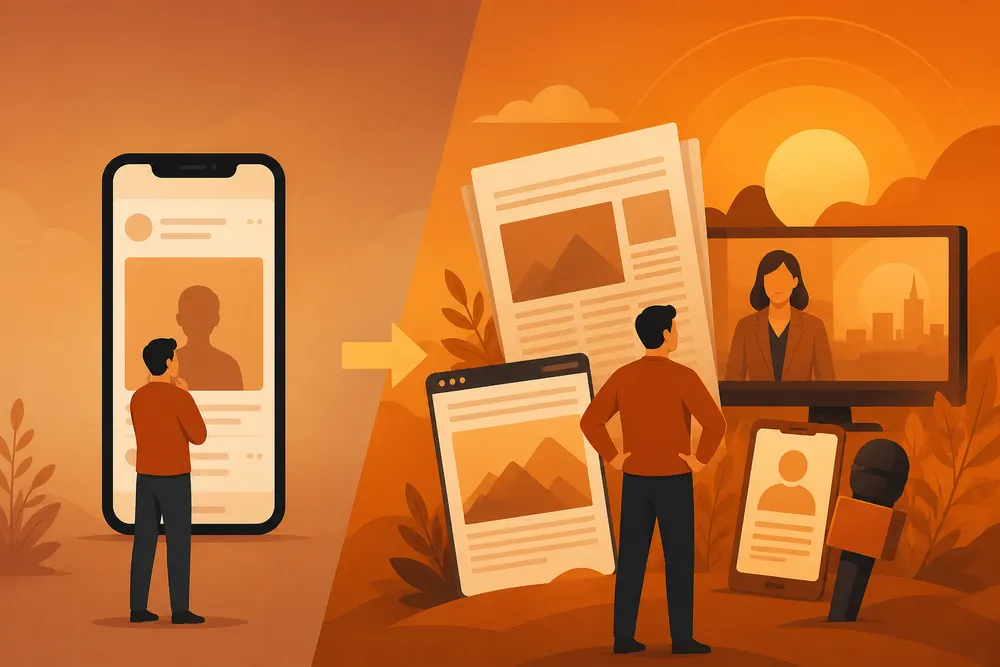
Why Doesn't Self-Published Content Build Credibility?
Every word on your LinkedIn profile is something you chose to say about yourself. That's valuable for staying visible to people who already follow you, but it carries zero third-party validation. A prospect evaluating whether to trust you can't distinguish a genuinely credible post from a well-written one, the platform doesn't verify the claims, it just distributes them.
This isn't a flaw specific to LinkedIn, it's true of any channel you fully own and control. A company blog has the same limitation. The moment you're the only author and the only editor, the content stops carrying outside validation no matter how polished it looks.
Who Actually Sees Your LinkedIn Posts?
The algorithm mostly shows your posts to your existing network and people similar to them. It's excellent for deepening relationships with people who already know you and close to useless for reaching someone doing due diligence on you for the first time, which is usually the exact moment you most need to make a strong impression.
Think about the last time you researched an unfamiliar vendor or executive. You didn't scroll their LinkedIn feed looking for posts, you searched their name and read whatever came up first. If nothing outside their own channel exists, LinkedIn never even enters that search.
Where Does LinkedIn Fit in a Real Visibility Strategy?
LinkedIn content works best downstream of something with more authority behind it, a press placement, a notable interview, a piece of third-party coverage. Posting about a CNBC segment you were featured in does something a standalone post never can: it lets you talk about yourself while pointing at proof that isn't self-published.
The order matters. Build the third-party credibility first, then let your own channels amplify it, not the other way around. Posting your opinions for a year before any outside validation exists builds an audience, but it doesn't build the kind of credibility that survives a stranger's five-minute background check.
"How do you cut through the noise? You cut through the noise by genuinely developing trust... build trust in that process, thought leadership in that process, and ultimately command attention from an audience."
Neal Goyal, GTM Leader, on the podcast
What Does a Complete Strategy Actually Look Like?
A complete visibility strategy has three layers working together: third-party validation (press, a credible host, an established outlet), owned content that references and extends that validation (LinkedIn posts pulled from the same conversation), and distribution that puts both in front of people who don't already know you.
LinkedIn is one piece of the third layer, not a replacement for the first two. Treat it as the amplifier it's good at being, and the whole system works a lot better than LinkedIn ever could on its own.
What If You've Already Built a Big LinkedIn Following?
A large, engaged following is a real asset, it's just a distribution asset, not a credibility one. It means more people will see whatever you point them toward, which makes it even more valuable to have third-party coverage worth pointing them toward in the first place.
Executives with big followings and no outside coverage are often sitting on an amplifier with nothing loud enough to amplify. Adding real press into the mix tends to produce a noticeable jump in how that existing audience engages, because for once there's something to share that isn't just another opinion post.
What Does the Right Sequence Actually Look Like?
Start with a single recorded conversation, a podcast, a video interview, something with a real host and a real audience outside your own. Turn that into a press placement or feature article. Only then start posting on LinkedIn about it, referencing the coverage, sharing a clip, pulling out a quote.
Done in that order, every LinkedIn post has something to point to besides your own opinion. Done in reverse, with LinkedIn first and press as an afterthought, you end up with a large following and nothing outside your own feed to show a skeptical prospect who wants proof rather than more content.
What About Executives Who Don't Post at All?
The absence of a LinkedIn presence isn't the real problem either, it's a symptom of the same gap. An executive with no LinkedIn activity and no press coverage is simply invisible from both directions, there's nothing self-published and nothing third-party to find.
Starting a LinkedIn habit from zero without anything to reference tends to produce generic, opinion-only content because there's no raw material to pull from. Starting from a recorded interview instead gives every post a real anchor, a segment aired, a feature published, a specific thing that actually happened, which is a much easier habit to keep up than manufacturing an opinion every week.
Press plus content from one interview
Premium Interview Package
Guaranteed MSN.com feature, LinkedIn posts, video clips, and guaranteed reach, without broadcast weight. Ideal when you need third-party proof fast.